Frontend
Operator workspace
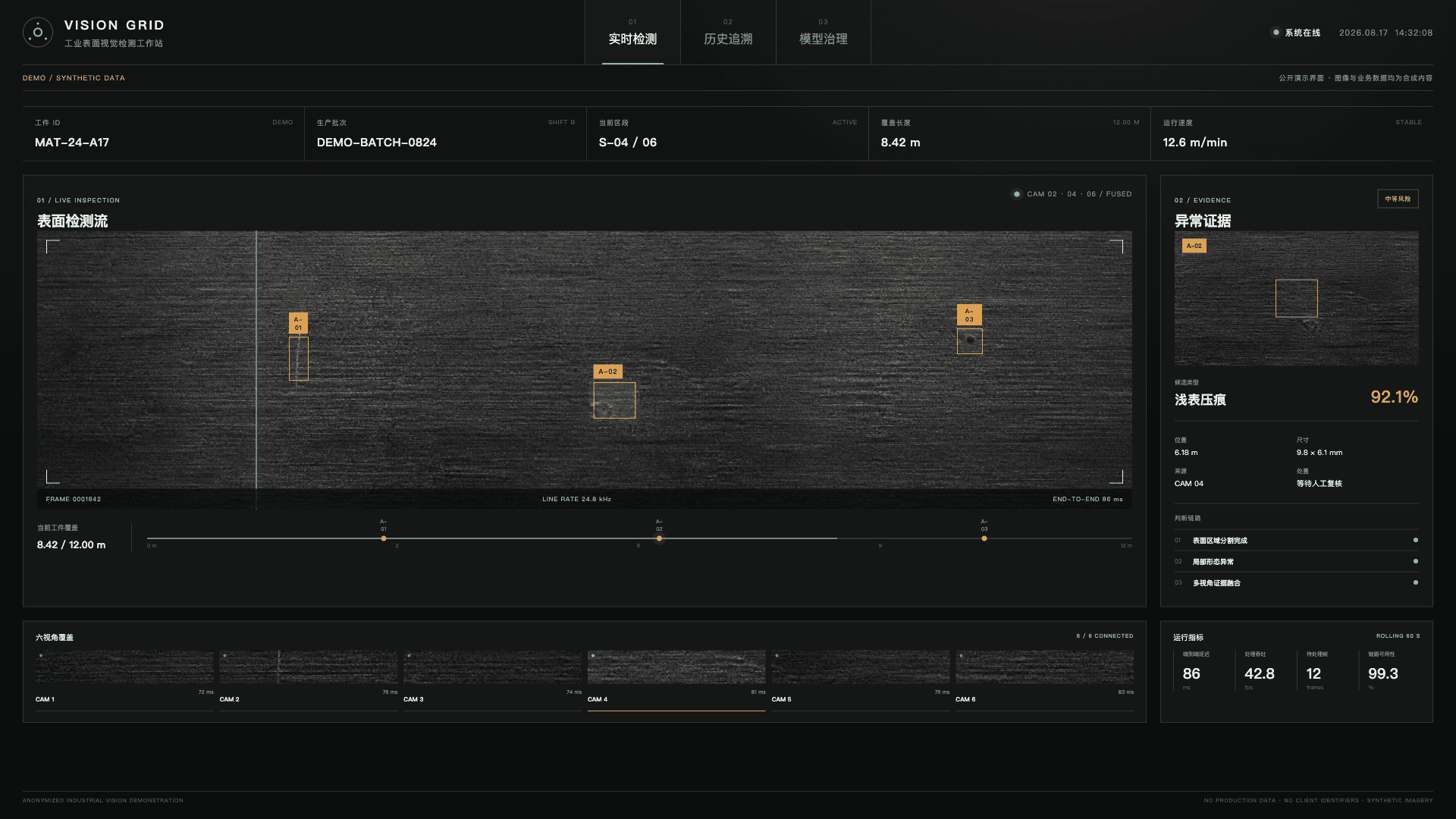
- Six-camera overview, fused view, and focused inspection
- Live runtime state and defect-event updates
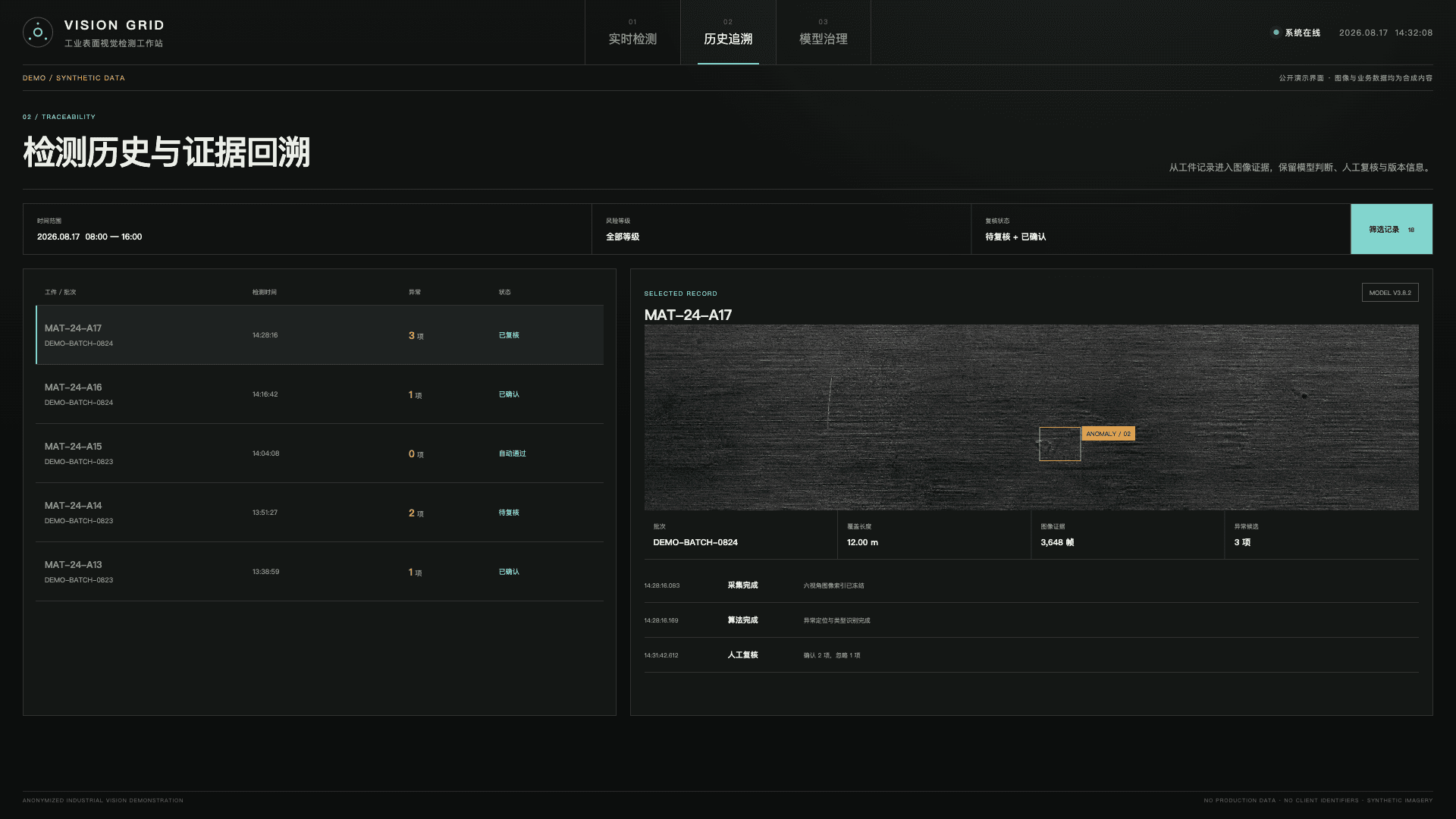
- History retrieval and image-level review
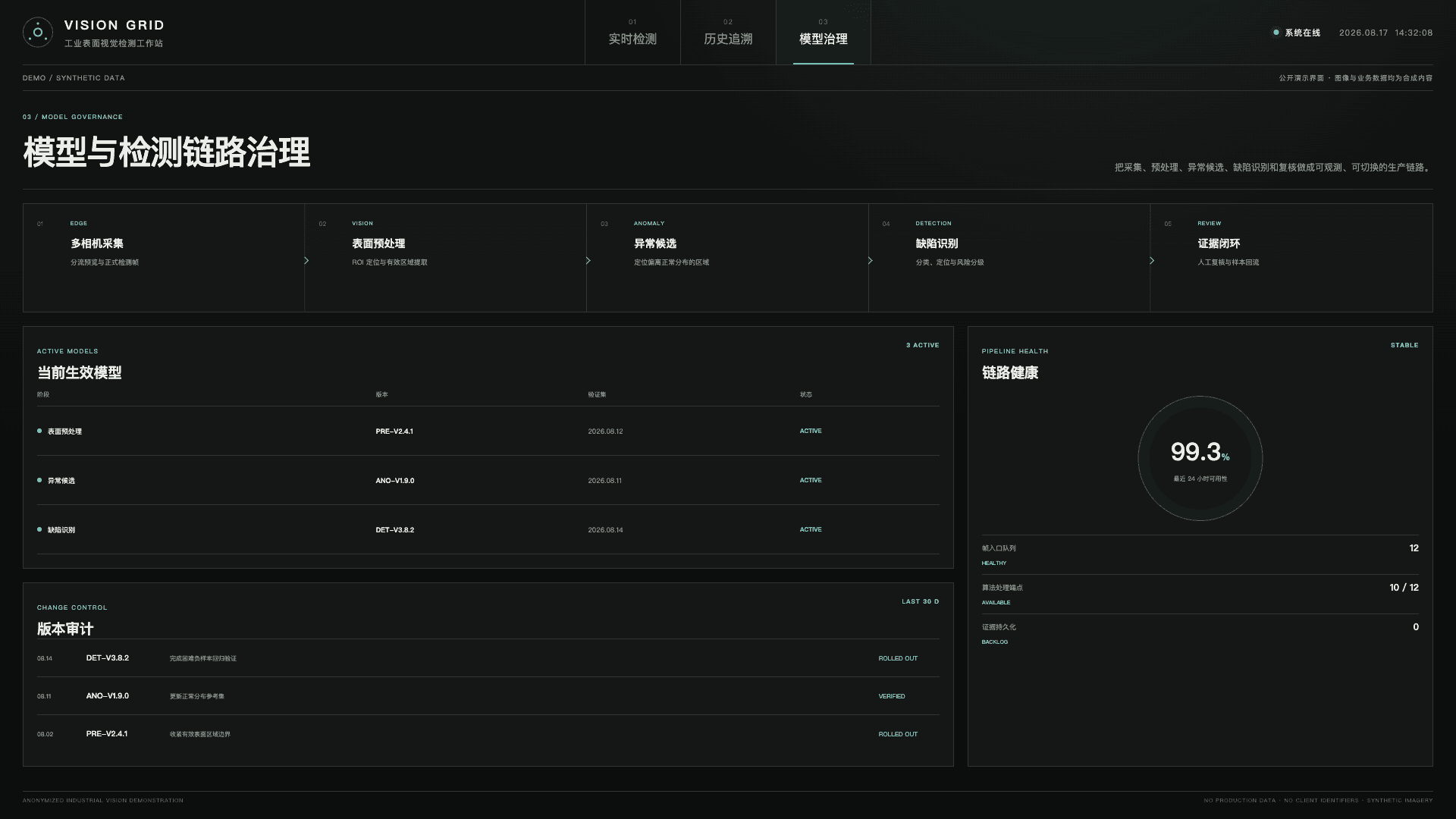
- Model, sample, parameter, and alarm governance
One production chain from acquisition to evidence, review, and model governance.
01 / Overview
02 / Product evidence
These screens preserve the operational structure of live inspection, evidence traceability, and model governance, while replacing all client identifiers, production imagery, business records, and metrics with explicitly synthetic content.
03 / The problem
Constraints
01Six-view acquisition and edge bandwidth02Preview and formal detection isolation03Workpiece and section lineage04Rare defects and hard negatives05Durable review evidence04 / System approach
Preview frames travel directly from edge capture to the browser, while formal frames are persisted and acknowledged before asynchronous inference. Runtime state, defect events, image evidence, and review changes remain separate but traceable contracts.
05 / System architecture
The architecture separates runtime control, latest-only preview, and durable formal inspection. The public description preserves verified software boundaries and waiting semantics while omitting client identity, site topology, storage addresses, alarm thresholds, credentials, capacity settings, and production parameters.
Operator workspace
Business truth and orchestration
Six-view edge acquisition
Vision inference service
05.1 / MODULE COMMUNICATION MAP
Control, preview, and formal inspection have different consistency and latency goals. Separating them prevents operator visibility, business truth, and inference throughput from blocking one another.
Establish the current workpiece, section, and phase
Own runtime state and the frozen context
Use the complete snapshot to permit formal frames
Build per-camera, focused, and fused previews
Older views may be overwritten under pressure
Consume preview without waiting for inference
Bind frame, workpiece, section, and camera identity
Keep large image bytes in the data plane
Queue the path and context, then release capture
Read by location and run preprocess, anomaly, and defect
Persist, emit deltas, and review on demand
Key rule: preview frames may be overwritten; formal frames require frozen identity, a durable location, and a retryable processing record.
05.2 / FORMAL INSPECTION FLOW
The capture callback forks immediately. Preview serves operator visibility; the formal branch builds durable lineage from original image and job to model result and human review.
Confirm the current workpiece, section, and phase
Include formal-binding permission and frozen context
Split preview frames from formal frames at the source
No business queue or durable record; freshness wins under pressure.
Submit location and frozen metadata only after the write succeeds.
ACK means scheduled—not inspected.
The queue absorbs inference variance; workers form micro-batches.
Read shared images and preserve source coordinates through ROI, anomaly, and defect stages.
Map results back to frame, camera, section, and model version.
Lightweight events update live state; REST loads complete evidence.
INVARIANTEven when inference returns late, a result can only update the frame and section frozen at ingress; it must never infer ownership from the browser's current state.
05.3 / KEY SEQUENCE
The order and waiting boundaries matter: persist the original before submitting metadata; acknowledge ingress without waiting for the model; send a lightweight delta before loading full evidence on demand.
Only public software contracts are shown. Site addresses, credentials, thresholds, capacity settings, and production performance remain private.
Create the authoritative workpiece and section context.
Provide the authoritative identity and gate conditions for formal capture.
Deliver latest-only camera and fused views without entering the formal path.
Submit image locations with frozen business context after durable write.
Decouple fast acknowledgement from bounded micro-batch inference.
Return detections that are persisted and mapped to frame and section lineage.
Serve history and detail on demand while pushing lightweight live deltas.
The backend establishes the current workpiece and section; capture freezes that context onto each formal frame.
Capture writes the original image first, then submits its storage location and metadata instead of moving image bytes through the API.
The backend validates and quickly acknowledges ingress, placing durable work on Redis so acquisition is not blocked by inference.
Workers group bounded jobs; the algorithm service reads shared images and runs preprocessing, ROI, anomaly, and defect stages.
Returned detections are attached to their frozen lineage, stored, and reduced to lightweight realtime events.
Operators retrieve full evidence on demand; review outcomes feed sample curation and controlled model iteration.
06 / Technical challenges
Use latest-only edge streams for operator visibility while reserving durable storage and inference capacity for formally bound frames.
Freeze workpiece and section context with each formal frame so delayed inference cannot attach evidence to a newer production state.
Index full-section imagery, map detections back to camera and position, and load detailed evidence on demand instead of flooding the browser.
Separate preprocessing, anomaly, and defect model versions, then connect review outcomes and sample governance to controlled iteration.
07 / Outcome
The capabilities below were verified against the internal implementation and maintained engineering documentation. Client identity, site topology, production imagery, throughput, accuracy, alarm rules, and deployment addresses remain private. Every number shown in the public UI is illustrative—not a production result.